
Speed or Control: Picking the Right Casino Launch Model
Every online casino launch boils down to one choice: speed or control. White-label platforms let you go live fast with lower upfront costs but limited customization, while turnkey solutions take longer and cost more upfront, yet give you full ownership, flexibility, and long-term control. GBO Gaming supports both approaches, providing access to over 11,700 games, 500+ payment methods, and full operational support. This guide compares both models for 2026, helping you choose the right path based on budget, timeline, and business goals.
TL;DR
-
White Label: Fast launch (2–4 weeks), low upfront cost (€20k–€50k), limited customization, revenue share model, ideal for startups.
-
Turnkey: Full ownership, unlimited customization, longer build (3–6 months), higher upfront cost (€100k–€500k+), best for scaling operators.
-
Hybrid Approach: Start with white label to test the market, migrate to turnkey as revenue and scale justify investment.
-
GBO Gaming Support: Access 11,700+ games, 500+ payment methods, full operational support, and flexible licensing options.
-
Key Decision Factors: Budget, speed, control, technical capacity, and long-term strategy.
White Label vs Turnkey Casino: Which Should You Choose?
Choosing between a white label and a turnkey casino usually comes down to a few practical realities. Once you’re clear on budget, timing, experience, and how much control you want long term, the choice tends to make itself.
A white-label casino makes sense if
- You’re working with a budget under €50,000 and want to get to market without tying up a large amount of capital upfront. White-label platforms are designed to lower the barrier to entry and let you launch without committing to a full build.
- You need to go live fast. If your priority is speed, whether to test a market, meet a deadline, or start generating revenue, a two to four week launch window is hard to beat.
- You’re launching your first casino, or you don’t want to deal with technical overhead. With white label, the provider handles the platform, integrations, updates, and maintenance, so your focus stays on marketing, player acquisition, and operations.
- You want to limit risk while you validate demand. Revenue share and a managed platform mean lower exposure if the market doesn’t perform as expected.
A turnkey casino is usually the better option if
- You’re prepared to invest more than €150,000 upfront and want to avoid giving away a percentage of revenue as the business grows. For operators planning scale, owning the platform often makes more financial sense over time.
- You’re not under pressure to launch immediately. A three to six-month development cycle gives you the space to define requirements, build custom features, and properly test before going live.
- You already have operational experience or an existing player base. Established operators are better positioned to take on the responsibility that comes with full platform ownership.
- You want complete control over how the casino works and evolves. Turnkey solutions allow you to build proprietary features, tailor payments and bonuses, and adapt the platform as your strategy changes.
White Label vs Turnkey Casino Platform Comparison
| Feature | White Label | Turnkey |
|---|---|---|
| Setup Cost | €20,000-€50,000 | €100,000-€500,000+ |
| Timeline | 2-4 weeks | 3-6 months |
| Revenue Model | Revenue share (15-30%) | Full ownership (0% share) |
| Ownership | License from the provider | Full IP ownership |
| Customization | Limited (branding only) | Unlimited (custom features) |
| Games | 11,700+ (provider library) | Custom selection |
| Payment Methods | 500+ (pre-integrated) | Custom integration |
| Maintenance | Included (provider handles) | Self-managed or outsourced |
| Scalability | Limited by the provider | Unlimited |
| Best For | Startups, budget-conscious | Established, high-volume |
What Is White Label Casino Software?
White-label casino software is a ready-made online casino platform you license from a technology provider. Instead of building software yourself, you launch on an existing platform that’s rebranded with your own name, visuals, and domain.
The underlying technology, including the platform logic, game integrations, payments, back office, and compliance tooling, remains owned and operated by the provider. You run the casino on top of that infrastructure, usually under a master license or sub-license, and pay either a revenue share or a fixed commercial fee.
How White Label Works
1. You select a white-label provider
Your choice of provider sets the boundaries of what you can offer. It determines which games are available, how payments work, what licenses you can operate under, and how much flexibility you’ll have later. For example, GBO’s white-label platform gives you access to more than 11,700 games and a fully managed technical stack.
2. You sign the commercial and licensing agreement
You enter into a white-label agreement, typically based on a revenue share or a fixed monthly fee. In many setups, you operate under the provider’s master license or sub-license, which means you can launch without securing your own standalone gaming license upfront.
3. You apply your branding and basic configuration
Your casino is branded with your logo, color scheme, and domain. At this stage, you’ll also configure currencies, languages, and bonus rules within the limits of the platform. The core product stays the same; you’re customizing presentation, not functionality.
4. You activate pre-integrated payment methods
Instead of negotiating and integrating payment service providers yourself, you choose from the provider’s existing payment stack. This usually includes cards, e-wallets, bank transfers, and alternative payment methods, often covering hundreds of options across regions.
5. You test and launch
Once configuration and payment testing are complete, the casino goes live. From signing the agreement to launch, the process typically takes two to four weeks, depending on approvals and setup complexity.
See also: What is the process of starting a white label online casino
White Label Cost Breakdown
| Cost Category | Amount | Notes |
|---|---|---|
| Setup fee | €20,000-€50,000 | One-time |
| Revenue share | 15-30% NGR | Monthly |
| Payment processing | 3-8% | Per transaction |
| Maintenance | Included | Provider handles |
| Year 1 (€1M GGR) | €200,000-€350,000 | Including revenue share |
White Label Pros
- Fast launch: You can be live within 2–4 weeks, making white-label the fastest route to market.
- Low upfront cost: Typical setup costs sit between €20,000–€50,000, compared to €100,000+ for turnkey.
- No technical expertise required: The provider handles the platform, integrations, hosting, updates, and maintenance.
- Proven platform: You’re launching on software that’s already in production, with an established game library and tested workflows.
- Built-in compliance: AML, KYC, and responsible gambling tools are included, reducing regulatory setup effort.
- Payments ready out of the box: Access to 500+ pre-integrated payment methods, including cards, e-wallets, bank transfers, and alternative methods.
White Label Cons
- Ongoing revenue share: You typically give up 15–30% of net gaming revenue, which directly impacts margins.
- Limited customization: Beyond branding and basic configuration, you can’t build unique features or proprietary mechanics.
- Provider dependency: Your operation depends on the provider’s stability, roadmap, and commercial terms.
- Reduced control: Core platform features and technical decisions remain outside your control.
- Higher long-term cost: On €1M annual GGR, revenue share can exceed €300,000 over three years, often outweighing turnkey costs.
- Competitive overlap: You’re running on the same underlying platform as other operators, making differentiation harder.
Explore GBO White Label Casino Software →
What Is a Turnkey Casino Solution?
A turnkey casino solution is a custom-built online casino platform developed specifically for you. Unlike white label, you’re not licensing an existing platform, but commissioning a platform that you own, control, and operate independently.
You own the codebase, the platform logic, and the data. There’s no revenue share, no shared infrastructure, and no dependency on a provider’s roadmap. In exchange, you take on higher upfront costs, longer development timelines, and responsibility for ongoing maintenance and operation.
How a Turnkey Casino Works
1. You define the requirements
The process starts with specifying exactly what you want to build. This includes core features, front-end design expectations, game coverage, payment methods, compliance requirements, and any proprietary functionality you need.
2. The platform is developed
Development follows those requirements and typically takes three to six months. During this phase, the platform logic, back office, player flows, and integrations are built specifically for your operation.
3. A custom UI/UX is designed
Unlike white-label templates, turnkey allows a fully custom front end. The UI and player experience are designed around your brand, target audience, and product strategy, rather than fitting into predefined layouts.
4. You integrate game providers
You choose which game providers to work with and integrate them directly into your platform. This gives you control over game mix, commercial terms, and the ability to add or remove providers as your strategy changes.
5. You build your payment stack
Payments are integrated individually based on your target markets. This can include cards, local payment methods, e-wallets, bank transfers, or crypto, negotiated and connected specifically for your operation.
6. You test and launch
Before going live, the platform goes through QA, payment testing, and compliance checks. Most operators run a soft launch before opening fully, ensuring stability before scaling traffic and acquisition.
Turnkey Cost Breakdown
| Cost Category | Amount | Notes |
|---|---|---|
| Development | €100,000-€300,000 | One-time |
| Game integrations | €20,000-€50,000 | Per provider |
| Payment integrations | €10,000-€30,000 | Custom PSPs |
| Infrastructure | €5,000-€15,000/month | Servers, CDN |
| Maintenance | €10,000-€30,000/year | Updates, support |
| Year 1 Total | €200,000-€500,000+ | No revenue share |
Turnkey Pros
- Full ownership: You own the platform outright and keep 100% of revenue, with no ongoing revenue share.
- Unlimited customization: You can build proprietary features, custom bonus logic, gamification, and integrations without platform restrictions.
- Competitive differentiation: A custom platform allows you to offer a product your competitors can’t replicate.
- Scalability without limits: You’re not constrained by a provider’s infrastructure, roadmap, or commercial terms.
- Full control: You can modify, integrate, and optimize the platform as your business and regulatory needs evolve.
- Long-term cost efficiency: Eliminating revenue share can save €300,000+ over three years at an annual GGR of €1M, often offsetting the initial build cost.
Turnkey Cons
- High upfront investment: Initial costs typically range from €100,000 to €500,000+, depending on scope and integrations.
- Longer time to market: Development, integration, and testing usually take three to six months before launch.
- Technical expertise required: You’ll need an in-house team or a reliable development partner to build and operate the platform.
- Ongoing maintenance responsibility: Updates, bug fixes, security, and compliance are your responsibility, not the provider’s.
- Platform risk: Unlike white-label, the platform isn’t battle-tested at launch, so thorough testing and a staged rollout are essential.
- More complex payment setup: Payment providers must be negotiated and integrated individually, which adds time and operational overhead.
Explore GBO Turnkey Casino Solutions →
Total Cost of Ownership: 3-Year Comparison
Upfront pricing only tells part of the story. To understand the real financial impact of choosing white label versus turnkey, you need to look at the total cost of ownership over time, including revenue share, maintenance, and how costs scale as revenue grows.
To keep the comparison grounded, the calculations below are based on a simple, realistic scenario that reflects how many operators evaluate platform costs before launch.
Assumptions used in this comparison:
- Annual Gross Gaming Revenue (GGR): €1,000,000. This represents a modest but meaningful level of traction for a live casino and is often where revenue-share costs start to become noticeable.
- White label revenue share: 20% of Net Gaming Revenue (NGR). NGR is assumed to be 80% of GGR, after bonuses and player incentives. Revenue share is applied annually and continues for as long as the casino operates on the white label platform.
- Turnkey maintenance: €20,000 per year. This covers ongoing platform support, updates, and basic operational maintenance, with no revenue share applied.
Using these assumptions, the sections below compare how costs accumulate over three years for both models, showing when upfront savings from white label are overtaken by ongoing revenue share, and where turnkey begins to deliver lower long-term cost despite higher initial investment.
White Label (3 Years)
| Year | Setup | Revenue Share (20% NGR) | Total |
|---|---|---|---|
| Year 1 | €30,000 | €160,000 | €190,000 |
| Year 2 | — | €160,000 | €160,000 |
| Year 3 | — | €160,000 | €160,000 |
| Total | €30,000 | €480,000 | €510,000 |
Turnkey (3 Years)
| Year | Setup | Maintenance | Total |
|---|---|---|---|
| Year 1 | €200,000 | €20,000 | €220,000 |
| Year 2 | — | €20,000 | €20,000 |
| Year 3 | — | €20,000 | €20,000 |
| Total | €200,000 | €60,000 | €260,000 |
In this scenario, a turnkey casino saves approximately €250,000 over three years, with the higher upfront investment breaking even at around 15 months. Beyond that point, every additional year of operation widens the cost advantage in favor of turnkey, particularly as revenue scales.
Customization Options Comparison
| Customization | White Label | Turnkey |
|---|---|---|
| Branding (logo, colors) | ✅ Full | ✅ Full |
| UI/UX design | ❌ Template only | ✅ Custom |
| Game selection | ❌ Provider library | ✅ Custom providers |
| Payment methods | ❌ Pre-integrated only | ✅ Custom PSPs |
| Bonus engine | ⚠️ Limited | ✅ Unlimited |
| CRM tools | ⚠️ Provider tools | ✅ Custom CRM |
| Proprietary features | ❌ Not possible | ✅ Unlimited |
| API integrations | ⚠️ Provider-dependent | ✅ Any integration |
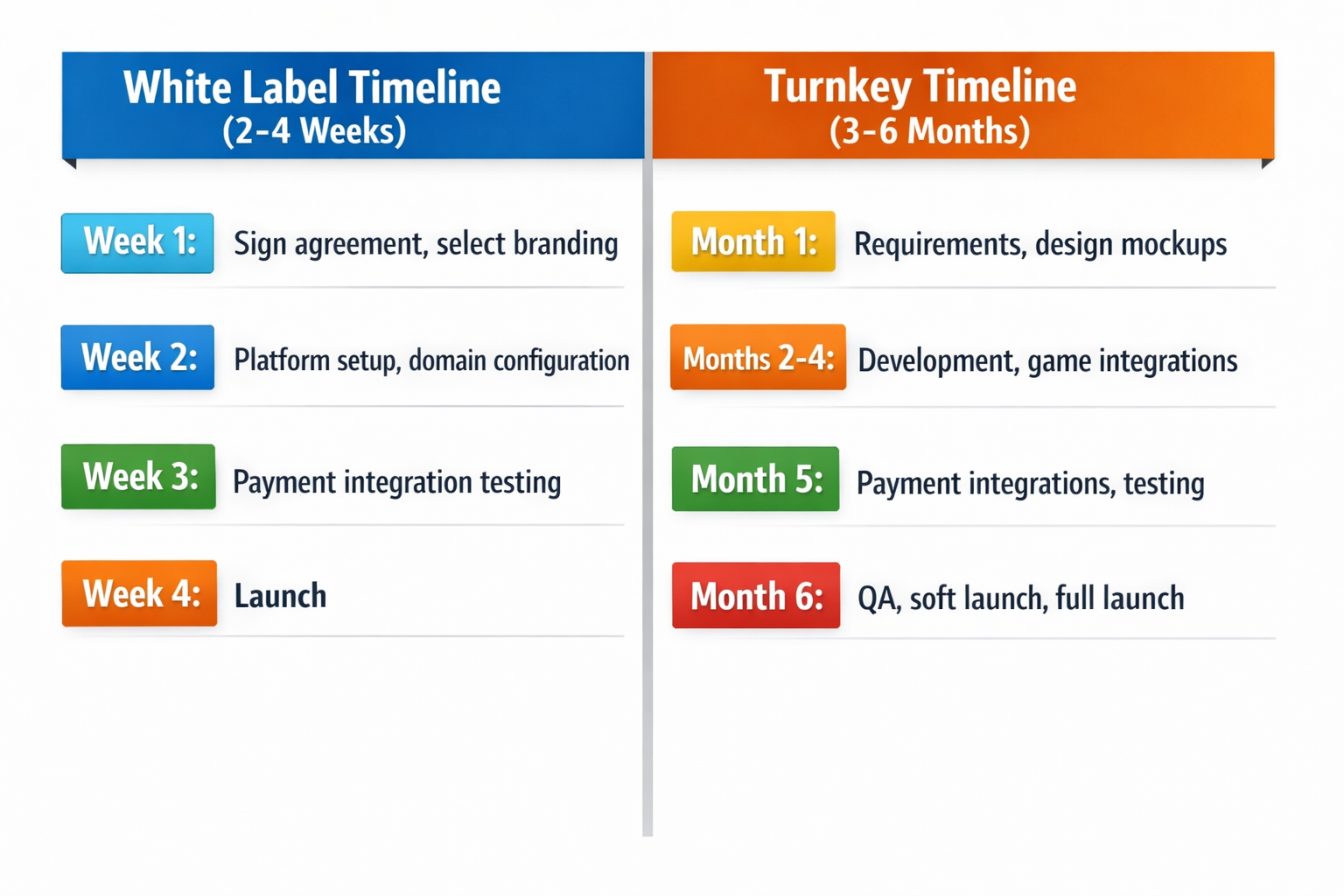
Timeline Comparison: How Long to Launch?
White Label Timeline (2-4 Weeks)
- Week 1: Sign agreement, select branding
- Week 2: Platform setup, domain configuration
- Week 3: Payment integration testing
- Week 4: Launch
Turnkey Timeline (3-6 Months)
- Month 1: Requirements, design mockups
- Month 2-4: Development, game integrations
- Month 5: Payment integrations, testing
- Month 6: QA, soft launch, full launch
Ownership and Control Comparison
Ownership and control shape how resilient, flexible, and valuable your casino becomes over time. Beyond technical considerations, they influence legal exposure, operational independence, and how easily you can adapt the business as markets, regulations, or commercial priorities change.
White Label
- Platform ownership: The platform IP is owned by the provider, not you. You operate the casino on licensed software, which limits your ability to influence core functionality or future development.
- Licensing model: Most white-label setups rely on a master license or sub-license held by the provider. While this simplifies launch, it also ties your operation to the provider’s regulatory standing and contractual terms.
- Exit risk: If the provider experiences financial trouble, loses a license, or sunsets the platform, your casino can be forced offline with limited notice and few alternatives.
- Data access: You typically have access to standard reports and dashboards, but raw data and backend systems remain under the provider’s control, which can limit advanced analytics or migration.
- Portability: Moving away from a white-label platform is often complex. Player data, integrations, and platform logic are tightly coupled, making migration costly, slow, or in some cases impractical.
Turnkey
- Platform ownership: You own the platform IP and codebase outright, giving you full authority over how the software is used, modified, or extended over time.
- Licensing model: You operate independently, managing your own licensing and compliance framework without relying on a third party’s master license.
- Exit risk: Significantly lower. Because you control the platform and infrastructure, your operation isn’t exposed to a provider’s commercial or operational decisions.
- Data access: You have unrestricted access to player, transaction, and operational data, enabling deeper analysis, better optimization, and easier regulatory reporting.
- Portability: High. You can move hosting providers, replace individual service vendors, or reconfigure infrastructure without rebuilding the platform, giving you long-term flexibility and resilience.
Which Model Is Best for Your Business?
There’s no universal “right” answer; the better model depends on where you are as an operator, how much capital you’re willing to commit, and how you plan to grow. Looking at common scenarios makes the decision much clearer.
White Label Is Usually the Better Fit If
You’re a first-time operator testing the market
If you’re entering iGaming for the first time, white label reduces complexity and lets you validate demand without building technology from scratch.
Your budget is under €50,000
White label keeps upfront investment low, making it accessible when capital is limited or needs to be preserved for marketing and acquisition.
You need to launch within one to two months
When timing matters, white label’s two-to-four-week setup window is difficult to match with any custom build.
You don’t have a technical team
Platform management, integrations, updates, and infrastructure are handled by the provider, so you don’t need in-house development resources.
You prefer a lower-risk entry
Using a proven, live platform reduces technical and operational risk while you test performance and refine your strategy.
Example: A new operator targeting Latin America with a €40,000 budget wants to test player acquisition and retention before committing to a larger investment. A white-label platform allows them to launch quickly, measure results, and adjust with limited exposure.
Turnkey Is Typically the Better Choice If
You’re an established operator looking to scale
Operators with existing experience or revenue are better positioned to manage the responsibilities that come with full platform ownership.
Your budget exceeds €150,000
Higher upfront investment makes sense when the goal is to avoid long-term revenue share and improve margins over time.
You can wait 3 to 6 months before launching
Turnkey development takes longer, but allows for deeper customization and more deliberate platform design.
You need proprietary features
Custom gamification, bonus mechanics, CRM logic, or unique player experiences require a platform you fully control.
You expect high volume
At €5M+ in annual GGR, revenue share costs on white-label platforms often exceed the total cost of a turnkey build.
Example: An operator with an existing player base and a €300,000 budget wants to migrate users to a fully owned platform, introduce custom bonus logic, and reduce long-term operating costs. A turnkey solution supports that transition and future growth.
Hybrid Model: White Label Now, Turnkey Later
For many operators, the choice between white label and turnkey doesn’t have to be permanent. A common strategy is to use white-label as a stepping stone, then move to a turnkey platform once the business has proven traction and revenue.
In the first year, you launch on a white-label platform. This allows you to enter the market quickly, keep upfront investment low, and test acquisition, retention, and monetization without committing to a full build.
In the second year, you focus on scaling. As the player base grows, you refine marketing, optimize payments, and build a clearer picture of lifetime value and operational costs.
In the third year, once revenue justifies the investment, you migrate to a turnkey platform. At this point, owning the platform helps reduce long-term costs, improve margins, and give you full control over features and the roadmap.
Benefits of the Hybrid Model
- Lower initial risk: You avoid a large upfront investment until you validate demand.
- Revenue validation: Real performance data helps justify a turnkey build instead of relying on projections.
- Time to prepare: You can assemble a technical team or development partner while the business is already generating revenue.
- Smoother transition: Planning the migration early reduces disruption when moving to a fully owned platform.
Migration Considerations
- Player data portability: Make sure your white-label contract allows player and transaction data to be exported for migration.
- Payment continuity: Check whether payment providers and merchant accounts can be carried over to the new platform.
- Brand and domain transfer: Ensure the domain, brand assets, and player-facing identity can be reused without interruption.
- Regulatory approvals: Confirm that licenses and approvals remain valid when switching platforms or operating independently.
When planned correctly, the hybrid approach combines the speed of white label with the long-term advantages of turnkey, without forcing you to commit too early.
GBO Gaming: White Label and Turnkey Solutions
Whichever route you choose, speed to market or full platform ownership, you don’t have to compromise on scale, coverage, or operational support. At GBO Gaming, you can launch on a white-label platform to move fast, or build a turnkey casino when control and long-term efficiency become the priority.
If you want to launch quickly, GBO’s white-label solution lets you go live in as little as two to four weeks, with setup costs typically between €20,000 and €50,000. You start with access to more than 11,700 games from over 50 providers, a payment stack covering more than 500 methods across cards, e-wallets, bank transfers, and crypto, and a fully integrated back office for CRM, analytics, and reporting. Licensing options are already in place, allowing you to focus on acquiring players rather than building infrastructure.
If you’re ready to invest in ownership, GBO’s turnkey solution gives you a platform built specifically for your business. You choose the game providers, define the feature set, and design the player experience from the ground up. The platform is developed over a three to six-month timeline, delivered with full IP ownership, a custom payment stack, and ongoing support and maintenance to ensure stability as you scale.
Whether you’re launching your first casino, scaling an existing operation, or planning a transition from white label to turnkey, GBO supports both models, so you can choose the path that fits your strategy today without limiting where you want the business to go next.
Schedule Consultation to Discuss Your Needs →
FAQs
Is white label or turnkey better for a startup?
For most startups, white label is the better option. It requires a smaller upfront budget, allows you to launch faster, and reduces technical and operational risk while you validate the market.
How much does a white-label casino cost compared to a turnkey?
A white-label casino typically costs €20,000–€50,000 to set up, plus an ongoing 15–30% revenue share. A turnkey casino usually requires €100,000–€500,000+ upfront, but there is no revenue share.
Can I switch from white label to turnkey later?
Yes. Many operators start with white-label to test the market, then migrate to a turnkey platform once revenue and scale justify the investment. This is a common growth path.
Do I need a gaming license for a white-label casino?
It depends on the provider and jurisdiction. Some white-label platforms allow you to operate under their master license or sub-license, while others require you to hold your own gaming license.
What’s the breakeven point between white label and turnkey?
At around €1M in annual GGR, the breakeven point is typically about 15 months. As revenue increases, the cost advantage of turnkey grows faster due to the absence of revenue share.
Can I customize a white-label casino?
Customization is limited. You can usually change branding elements such as logo, colors, and domain, but you can’t add proprietary features, unique game mechanics, or custom platform logic.

 Follow on LinkedIn